Showing posts with label Unit 30 - Camera and Lighting Techniques for Moving Image Production. Show all posts
Showing posts with label Unit 30 - Camera and Lighting Techniques for Moving Image Production. Show all posts
Wednesday, 16 January 2013
New Wave Shots
Here are examples of a close up shot and the cut away. The location for this footage was at Five Street Park in Nuneaton. The park has a reputation of being quite "rough" so we thought we could get some good footage there. Unfortunately The white balance was wrong so theres a blue tint to the shots but if it weren't for that these two would be really good. Both pieces of footage were filmed hand held with a Cannon 600.
Health & Safety
Having a reputation as a rough area we had be careful of where we were filming and where we were leaving the equipment. There were also precautions made for pieces of broken glass on the floor that people could fall on or tread on. We also made sure that no one went off filming on their own.
New Wave
The reason for these shots was because of the French new wave. I wanted to capture both smoking the cigarette and the finished burning on the floor so i could edit the footage and put jump cuts in to show the "life" of the cigarette.

Tuesday, 15 January 2013
Aperture
Aperture
In this shot we were doing some innovative filming techniques like the new wave directors would. you can see that the back ground in the shot is out of focus. This is because we were filming at around f/14 which creates a shallow depth of field.
This is the same shot but done again. This time we changed the aperture to f/22, which creates a bigger depth of field so the background is in focus swell as the fore ground. This made the shot look a lot better. I think it is a really nice new wave shot as well because of the innovative camera movement so its as if you are walking with me. I also break the fourth wall in this shot which has influence from the French New wave film 'Breathless' when it is highlighted at the end that the character is breaking the fourth wall.
In this shot we were doing some innovative filming techniques like the new wave directors would. you can see that the back ground in the shot is out of focus. This is because we were filming at around f/14 which creates a shallow depth of field.
This is the same shot but done again. This time we changed the aperture to f/22, which creates a bigger depth of field so the background is in focus swell as the fore ground. This made the shot look a lot better. I think it is a really nice new wave shot as well because of the innovative camera movement so its as if you are walking with me. I also break the fourth wall in this shot which has influence from the French New wave film 'Breathless' when it is highlighted at the end that the character is breaking the fourth wall.
Tuesday, 20 November 2012
Oxford trip
Recorded meeting 2
We held another meeting for the Oxford trip as it was a day when we needed to be really organised. In the meeting we discussed what locations we would visit, what shots we would take and how much time we would allow for each location shoot.
Recorded Meeting 1
When we started to go out and film on location we realised that we needed to be more organised with what were filming, where we were filming and different shot types that we were doing. we realised that the best way to get around this was to have meetings and record them. this way we could listen back over the recordings to see what was said.
Shutter Speed
Shutter speed
In this footage we were trying out some innovative camera movements so that we had shots in a new wave style. In this shot we were driving around and filming out of the window. Unfortunatley this shot did not look good as it is really blurry. This is because the shutter speed was not quick enough and was set at around 1/50.
This is another innovative camera movement in the car but this one is much clearer with no blurs because we made the shutter speed quicker at around 1/500
In this footage we were trying out some innovative camera movements so that we had shots in a new wave style. In this shot we were driving around and filming out of the window. Unfortunatley this shot did not look good as it is really blurry. This is because the shutter speed was not quick enough and was set at around 1/50.
This is another innovative camera movement in the car but this one is much clearer with no blurs because we made the shutter speed quicker at around 1/500
Evaluation
Overall I think the course so far has been successful. At the start of the course we started our research for our contextual work. The research went really well as I had a lot of books to look through which i got a lot of information from and we also took a trip to Coventry Uni Library . the trip to the library really help0ed as there was books there that i may not have been able to get my hands on so i took the opportunity to photo copy every bit of information i could. Once i had finished my research I made a start on the contextual. I think that my contextual work went quite good as I have never been very good at writing essays but I feel that my writing skills are now at a higher level. it also helped having plenty of research to write about. I also learnt How to use Harvard referencing which i thought was going to be really hard but turned out to be not that difficult.
The filming in the course was really enjoyable. I really liked going out and filming on location and learning about different camera techniques. When we first went out to film on location every one was a bit nervous about it as we were worried about people looking at us which, in Nuneaton we did get. This changed when we went to Oxford to film as it is a popular destination for tourists so we just looked like any other group of tourists. We used Nuneaton to film more "gritty" scenes or locations especially at Fife Street Park as there was vandalism on the kids playground and used condoms on the floor. This all added to the gritty feel and we managed to get some really good footage. Oxford was the complete opposite and thats why we went to film there. everything was really picturesque there and we got some really good footage from there. Before we went to Oxford we made a plan of what we were going to film and where. we decided on three main locations which were The Turf Tavern, Jericoh Street and an old record shop. We managed to get two out of the three as we didn't have time to make it to Jericoh Street as we were stopping on the way to different locations to film at other good locations such as an old fashioned sweet shop. The sweet shop was a really good place to film and we got some of our best footage filmed in there. We also spent quite bit of time in there because we were getting really good footage and we had permission to film in there for along as we wanted to. Another really good location we filmed was in an old record shop/coffee shop as the owners were really nice and said we could film as much as we wanted. In the record shop we got some really good cutaways and we got to try using the Boom mic. The boom mic did not go successfully as will did not realise that he was holding it next to a speaker, but we got to practise with it.
I feel that my "Blogging" could have been better as i should have put more videos of footage and i should have went into more detail when discussing various things. The reason why i didn't spend as much time on my blog as other work is because I'm not a strong essay writer, i spent most of my time worrying about that and writing draft after draft trying to get my grade up as much as possible rather than putting more effort into the blog.
The editing of all the footage was my favourite part of the unit as it finally gave me the chance to put my own creative feel to all of the footage we filmed together. at first I wasn't going to have a narrative or theme to my film but when i got more into the editing i realised that i was creating a theme with out realising it. The theme is of a journey to different locations and i have shown this through how i kept cutting back to a shot of a car wing mirror whilst the car is moving to represent the travelling part. Then i have used different shots of different locations along with different cut away shots. Because i have taken influence from New Wave cinema i have put innovative camera movements in my film to show this. We had to put music over the top of our film and were told that a sensible choice would be Post-Rock as this starts off slow and builds up. The music I chose was by a band called Peace and the song is called 1998 and it works really well with my film as different sounds at the start of the song fit the timing of my jump cuts that i put in.
Overall I think the course so far has been successful. At the start of the course we started our research for our contextual work. The research went really well as I had a lot of books to look through which i got a lot of information from and we also took a trip to Coventry Uni Library . the trip to the library really help0ed as there was books there that i may not have been able to get my hands on so i took the opportunity to photo copy every bit of information i could. Once i had finished my research I made a start on the contextual. I think that my contextual work went quite good as I have never been very good at writing essays but I feel that my writing skills are now at a higher level. it also helped having plenty of research to write about. I also learnt How to use Harvard referencing which i thought was going to be really hard but turned out to be not that difficult.
The filming in the course was really enjoyable. I really liked going out and filming on location and learning about different camera techniques. When we first went out to film on location every one was a bit nervous about it as we were worried about people looking at us which, in Nuneaton we did get. This changed when we went to Oxford to film as it is a popular destination for tourists so we just looked like any other group of tourists. We used Nuneaton to film more "gritty" scenes or locations especially at Fife Street Park as there was vandalism on the kids playground and used condoms on the floor. This all added to the gritty feel and we managed to get some really good footage. Oxford was the complete opposite and thats why we went to film there. everything was really picturesque there and we got some really good footage from there. Before we went to Oxford we made a plan of what we were going to film and where. we decided on three main locations which were The Turf Tavern, Jericoh Street and an old record shop. We managed to get two out of the three as we didn't have time to make it to Jericoh Street as we were stopping on the way to different locations to film at other good locations such as an old fashioned sweet shop. The sweet shop was a really good place to film and we got some of our best footage filmed in there. We also spent quite bit of time in there because we were getting really good footage and we had permission to film in there for along as we wanted to. Another really good location we filmed was in an old record shop/coffee shop as the owners were really nice and said we could film as much as we wanted. In the record shop we got some really good cutaways and we got to try using the Boom mic. The boom mic did not go successfully as will did not realise that he was holding it next to a speaker, but we got to practise with it.
I feel that my "Blogging" could have been better as i should have put more videos of footage and i should have went into more detail when discussing various things. The reason why i didn't spend as much time on my blog as other work is because I'm not a strong essay writer, i spent most of my time worrying about that and writing draft after draft trying to get my grade up as much as possible rather than putting more effort into the blog.
The editing of all the footage was my favourite part of the unit as it finally gave me the chance to put my own creative feel to all of the footage we filmed together. at first I wasn't going to have a narrative or theme to my film but when i got more into the editing i realised that i was creating a theme with out realising it. The theme is of a journey to different locations and i have shown this through how i kept cutting back to a shot of a car wing mirror whilst the car is moving to represent the travelling part. Then i have used different shots of different locations along with different cut away shots. Because i have taken influence from New Wave cinema i have put innovative camera movements in my film to show this. We had to put music over the top of our film and were told that a sensible choice would be Post-Rock as this starts off slow and builds up. The music I chose was by a band called Peace and the song is called 1998 and it works really well with my film as different sounds at the start of the song fit the timing of my jump cuts that i put in.
Wednesday, 14 November 2012
Editing for lighting
EDITING


At the moment i am currently editing my montage of shot types. It is so far my favourite thing that i have done on the course. The soft ware i am using is Adobe Premier Pro on a mac and is really good for editing. The film has to be between 3 and 5 minutes long and has to contain a variety of different shots and filming techniques we tried out. Whilst editing i tried to create a theme and it is the theme of traveling to places. for example between all the shots i have edited it to keep cutting back to an innovative shot of the wing mirror whilst we are moving in the car to show moving to different places or scenes. Depending on the outcome of the final product i don't know whether or not i will keep this theme. You can also create meaning through the use of montage. I have tried to do this by cutting back to the shot of the car wing mirror, this combined with footage of different places gives the meaning of traveling.
Tuesday, 13 November 2012
This is more footage from the low key shoot. the studio was pitch black and our key light source was a phone. in this shot we used a creepy looking doll. This worked really well in the low key light because it gives the doll a much more scary feel to it. the equipment we used for this footage was a cannon 5d, a tripod and the phone for key light.l we were shooting on aperture f/22 which worked really well. We used the iPhone as our key light because we took influence from French New wave cinema by using innovative light sources due to budgeting.
Thursday, 8 November 2012

White Balance

.
This is an example of some footage we had problems with white balance on. as you can see the whole shot is effected by the grainy blue colour. We were filming on aperture f/22 but we had not adjusted the ISO or frame rate. this is what caused this grainy blue colour. once we had realised we increased the ISO.
Prep For Oxford Shoot
Prep For Oxford Shoot

This is an example of pre Oxford filming day prep. We all got together and discussed what equipment we would need for the day. Sammy then sent an email around confirming this just incase we needed anything else or forgotten something. The whole day went really well and to schedule and this was down to planning.
Lighting
We filmed this footage in the photography studio. It is an example of using innovative light sources. for this shot we used two light sources one was a light on an iPhone and one was a small barn door light. This is one of my favorite shots we did because it creates a really nice low key light and the colours of the table cloth reflects the light really well. the barn door light was located towards the bottom right corner of the table to get a highly lit area of the table. we then had the iPhone located above the bowl towards the top left corner. The camera was at a high vantage point. This shots influenced by the "Kuloshev effect"and it is when you create meaning or emotion of a character through the use of editing. you do this by having a shot of the person then cutting away to a shot of food in this case. By doing this it tells the viewer that the character is hungry.
Aperture
Aperture

This is a diagram showing how to use aperture and what each one does. For most of our filming we shot on aperture f/22 as it lets less light and creates a deep depth of field.
As you can see in this shot, the actor is in focus but the background is out of focus. This is because the aperture would have been set at around f14 which creates a shallow depth of field. If i was to go back and do this shot again I would set the aperture to f22 to create a larger depth of field. we were using a dolly in this shot therefore next time i would also increase the shutter speed slightly. I would also make sure that the surface we were using the dolly on was smooth as the slightest bump on the ground could cause the shot to look really shaky.
New Wave
This shot was supposed to be influenced by new wave as we wanted to get a nice zoom out using the dolly to show how he is "trapped" by showing him behind the cage. Unfortunatley the shot did not work out as the surface was so un even.
Health & Safety
When filming this piece of footage we had to take some risks into consideration. One of which for this shot was that nothing was behind the dolly operator to cause them to trip up as they are walking backwards.
Recording Sound With an External Microphone


Sound
This footage we filmed in an old record shop. We basically wanted an interview with a worker about the music scene in Oxford so we could use the boom mic. As you can hear we had some problems with the boom mic as there was a speaker right next to where we had it positioned. The camera position and framing look really good and like a documentary style its just the sound that lets it down. For this shot we had the aperture set at f/8 so we had the ISO set at 400 and the shutter speed set at 1/250. We put the ISO up because we wanted to make the most out of the small amount of light that was in front of him. All of these made the shot look really nice and documentary style. The equipment we used in this was a Canon 500, tripod and the boom mic. Looking back on this shot if i could do it again I would make sure that we scan the room for anything that could damage the sound on the boom mic. This mistake with the boom mic led me to notice that in the American new wave film Easy Rider that I've researched for my contextual study, the opening scene is the two protagonists taking part in a drug deal but you can't hear anything they are saying because it has been smothered with the sound of aeroplanes flying over them. Seeing has made me realise i can still use the footage as a new wave influence.
Lighting
We chose to film in the window of the shop because we thought it would look good having the street behind him, which it did but we did not consider him being poorly lit. Looking back if i could have done this shoot again i would have ensured that we used the reflector to reflect light from the window onto the man so that he was evenly lit.
Health & Safety
For this shoot we were in a small record shop so we had to take a few risks into consideration. We had to make sure all bags and equipment we weren't using were stored out the way of any aisles so it weren't abstracting anyone walking. we also had to make sure the tripod wasn't in the way of any walking space so that people wouldn't trip over it. Every one had to be aware of the wires from the boom mic also.
Thursday, 25 October 2012
Camera: Oxford
These are two pieces of footage which we shot in Oxford. The first is an establishing shot where we used the panning technique. we chose this location because it is on Oxfords High street and the amount of different coloured buildings look really good for a shot with a high contrast of colour. for this shot we were filming in aperture f/22.5, the shutter speed was set at 1/500, ISO was 1600 and white balance was at 8000k. I think this shot works really well as an establishing shot as it captures a lot of different colours from the painted buildings.
The second piece of footage is an over the shoulder shot. It was my idea to get this shot whilst walking past the graffiti as i thought it would give a lot of colour to the shot which it did. I also think this shot works really well because its hand held camera work as well which gives a feeling of being followed which works really well. for this shot we were using aperture f22, shutter speed was 1/500, ISO was 3200 and white balance was 8000k.
Wednesday, 24 October 2012
Production techniques


Yesterday we went to Oxford to do some filming. Our main focus was to get some establishing shots, shots with high colour contrast, cutaways and getting some interviews using the boom mic. The day was successful and we got some of everything done. I think the shots that worked best were the establishing shots we did on the high street because its one nice fluid panning shot which can be used to set the scene nicely.
Saturday, 20 October 2012
Oxford Filming


Yesterday we went to Oxford to do some filming. We got some really good footage and it was a very productive day. we did a lot of planning before the day which ensured everything went smoothly.
Thursday, 18 October 2012
Kuleshov
Lev Kuleshov is a Russian filmmaker who edited together a short film where a shot of an expressionless face was matched with various other shots such as a plate of soup, a girl in a coffin and a woman on a divan. The audiences believed that each time the face expression would change and they praised the subtle acting. The effect was that effective the audience said they were deeply moved by how sorrowful the actor looked after the image of the dead child. The audience was not aware that the same shot of the actor's face was re-used, and the effect is created entirely by its superimposition with other images to express how the character is feeling.
Kuleshov used the experiment to indicate the usefulness and effectiveness of film editing. The implication is that viewers brought their own emotional reactions to this sequence of images, and then moreover attributed those reactions to the actor, investing his impassive face with their own feelings. Kuleshov believed this, along with montage, had to be the basis of cinema as an independent art form.
The effect has also been studied and used by famous director Alfred Hitchcock. An example of when he used this is explained in the famous "Definition of Happiness" interview, where he explains in detail many types of editing. The final one which he calls "pure editing", is explained visually using the Kuleshov effect. In the first version, Hitchcock is squinting, and the audience sees footage of a woman with a baby. The screen then returns to Hitchcock's face, now smiling. In effect, he is a kind old man. In the second example, the woman and baby are replaced with a woman in a bikini, to which Hitchcock exclaims, "Now look, he has become the dirty old man."
Kuleshov used the experiment to indicate the usefulness and effectiveness of film editing. The implication is that viewers brought their own emotional reactions to this sequence of images, and then moreover attributed those reactions to the actor, investing his impassive face with their own feelings. Kuleshov believed this, along with montage, had to be the basis of cinema as an independent art form.
The effect has also been studied and used by famous director Alfred Hitchcock. An example of when he used this is explained in the famous "Definition of Happiness" interview, where he explains in detail many types of editing. The final one which he calls "pure editing", is explained visually using the Kuleshov effect. In the first version, Hitchcock is squinting, and the audience sees footage of a woman with a baby. The screen then returns to Hitchcock's face, now smiling. In effect, he is a kind old man. In the second example, the woman and baby are replaced with a woman in a bikini, to which Hitchcock exclaims, "Now look, he has become the dirty old man."
Lighting
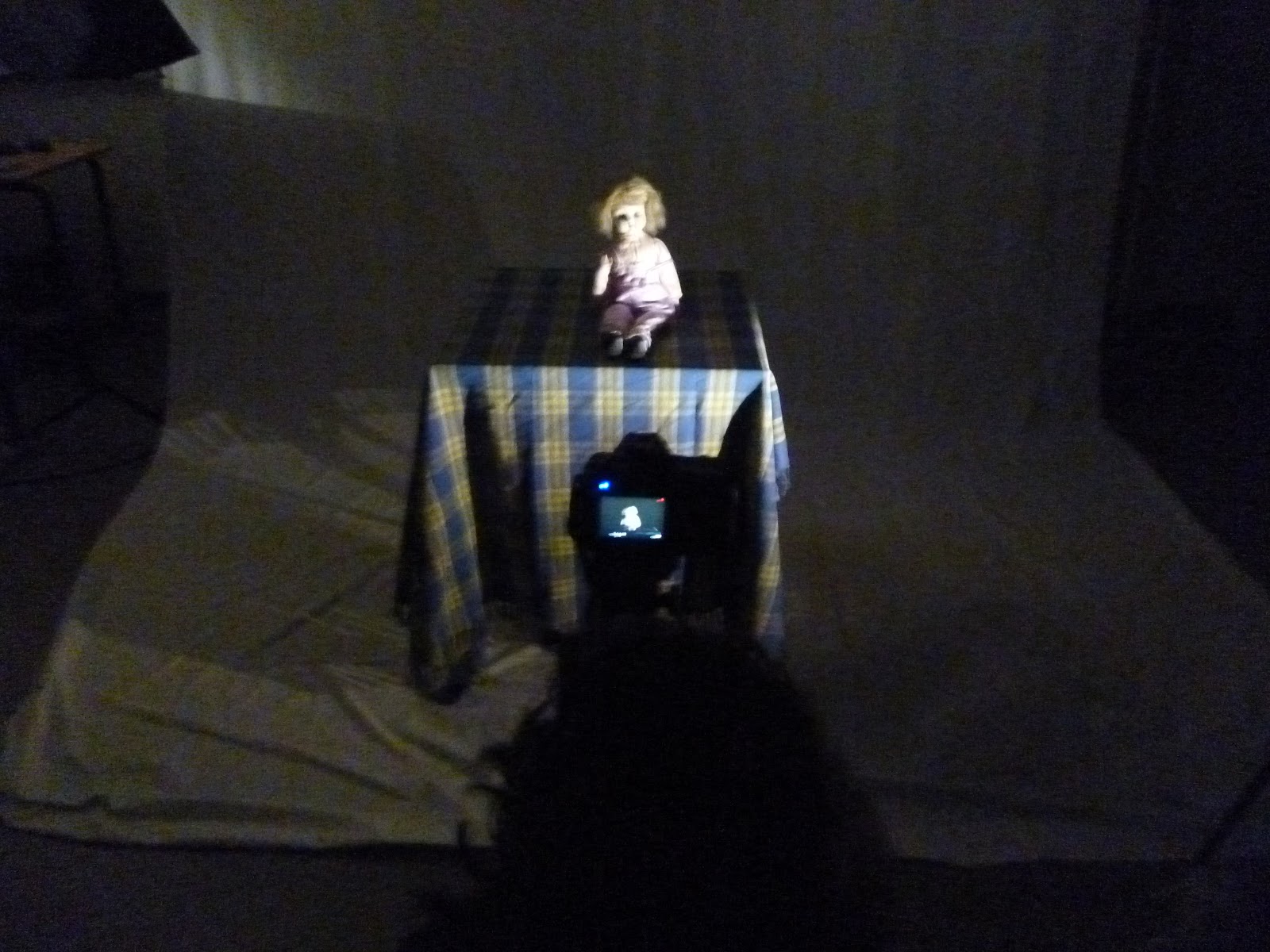


Here are some more photos from the low key lighting shoot. Low key lighting is used to make an object or person look either mysterious or dangerous. For low key lighting you only use one light source. Our light source was an iPhone light. in these photos we were trying out lighting up different props such as a skeleton and a creepy looking doll. The low key lighting worked really well on both of these especially the doll.
Wednesday, 17 October 2012
Eisenstein & Soviet Montage
Eisenstein was the pioneer in the use of montage in film. Cameras would have been expensive early in the century so finding ways to show different angles and action required developing a method of cutting that would propel the narrative or storyline. He argued that montage was the most important aspect to film because rather than just expanding a shot or sequence, cutting in a montage can manipulate the emotions of an audience and also create metaphors in the film and that visual metaphors elicit meaning. He believed that an idea should be derived from the juxtaposition of two independent shots, bringing an element of collage into film. He created what he called "methods of montage". He also used montage to manipulate an audiences perception of time. he also changed time and rhythm in a film to create a visceral response.
This video shows the "5 Methods of Montage" that Eisenstein pioneered. It goes through each one showing how it has influenced directors and how they have used it to change rhythm in film and how it is used to create meaning in the sequences.
This technique will be useful for forthcoming Units in Promotional Video and Music Video Productions as these types of film/video rely upon creating meaning through the meanings an audience creates whilst viewing connected images. With access to only single camera shooting productions this method would also be a good technique to remember as it allows the filmmaker to manipulate time and space.
This video shows the "5 Methods of Montage" that Eisenstein pioneered. It goes through each one showing how it has influenced directors and how they have used it to change rhythm in film and how it is used to create meaning in the sequences.
This technique will be useful for forthcoming Units in Promotional Video and Music Video Productions as these types of film/video rely upon creating meaning through the meanings an audience creates whilst viewing connected images. With access to only single camera shooting productions this method would also be a good technique to remember as it allows the filmmaker to manipulate time and space.
Camera: Oxford prep

Soon we will be going to Oxford with the college. We saw this as an opportunity to do some filming. I have been researching into some locations where to film and this one i think will be a great place to film. It is the Hertford Bridge that joins two parts of a college. it is very picturesque so I thought it would be a good place to get some footage.
Subscribe to:
Posts (Atom)